EarthScope Consortium is dedicated to supporting transformative global geophysical research and education. To that end, GeoLab is a JupyterHub that offers a customizable, cloud-based compute environment to geophysical researchers and educators for data analysis and visualizations.
GeoLab has been designed with analysis of geodetic and seismological data in mind, but it is not limited to these domains. Any research group looking to work with large, geophysical datasets or that would prefer not to maintain their own complicated compute environment could benefit from working in GeoLab.
Key Features of GeoLab:
Access to cloud compute resources at no cost to users: GeoLab is supported by federal grants from the National Science Foundation.
Scalable resources: You can select from a variety of compute resources, including several options for RAM and CPU. A baseline environment is available by default; larger servers and GPU access require administrator approval. See Resource Allocation for details.
Homogeneous compute environments: Creating identical compute environments is easy, ensuring that software versions are consistent from one user to another. This makes it an ideal platform for collaboration and as an educational tool.
Customizable environments: GeoLab is an ideal place to run Python notebooks in the cloud. You can install additional packages using pip or conda, or bring a fully custom Docker image. See Environment Management for details.
Accessibility: Since GeoLab operates in the cloud, anyone with a web browser and reliable internet connection can use it, regardless of their own computer’s operating system or tech specs.
Data Adjacency: GeoLab runs adjacent to the NSF NGF Data Repositories in AWS (us-east-2), giving you low-latency, high-throughput access to large volumes of data.
Hub Management
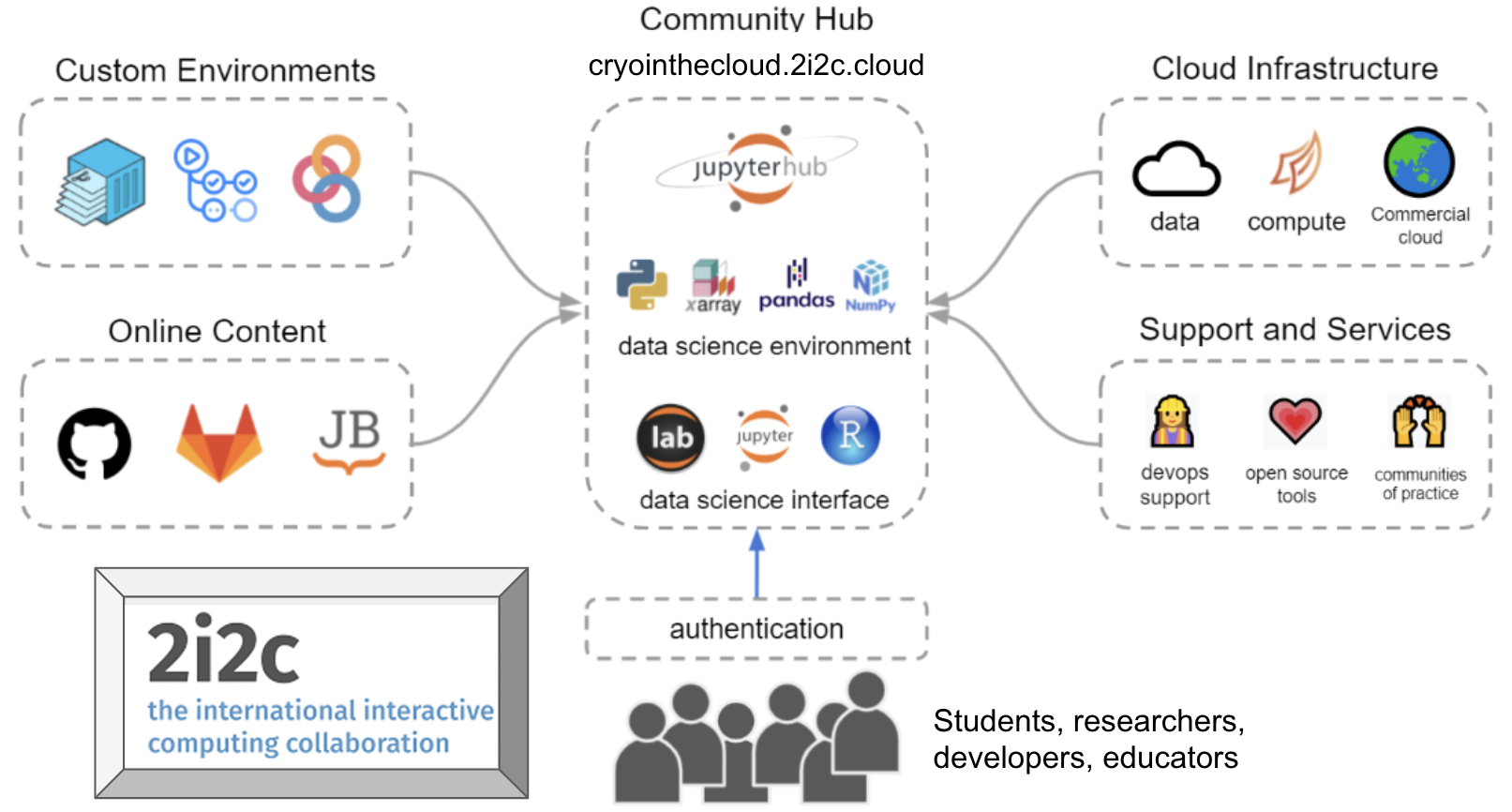
In collaboration with EarthScope, the GeoLab platform is built and maintained by International Interactive Computing Collaboration (2i2c), a non-profit organization that excels in using open-source tools to design and operate JupyterHubs for other institutions supporting research and education. The diagram below illustrates their service model.